MY HOCKEY DAYS
Until the age of eleven, I had only played football, tennis and cricket. However, in September 1955, I was packed off to boarding school – Kent College (“KC”) Canterbury. The following year, in the spring term, I picked up a hockey stick for the first time. In May 2024, I played my last game for the LX Hockey Club. This is the story of my hockey career, that spanned sixty-eight years.
In the late 1950’s, KC was one of the great hockey playing schools of England. Each year our First XI played against a Hockey Association side. On one occasion we beat the HA XI, so the following year, it despatched a side including Mike Kirby and John Cadman – both England internationals. Cadman at the time, was our PE and hockey master.
The hockey pitch at KC, was so good that the Kent Hockey Association, used to arrange county matches there, which we were permitted to watch. I remember one match against Yorkshire, where the Kent right half was Andrew Foot (Oxford University and Beckenham). Many years later, Andrew and I played for the same side at Sanderstead.
In my second year at KC, I started playing in ‘house’ hockey matches. My ‘house’ was Neville; the other two were Godwin and Windsor – now unfortunately defunct. In one match, I remember being shouted at, by one of our housemasters, for not holding my hockey stick the proper way. Being left-handed, it seemed natural to hold the stick with my left hand below my right. Apparently, this just wasn’t on. After the game ended, Mr R C Burt in charge of the Under 13’s, approached me and, in no uncertain terms, informed me that unless I learnt to hold my hockey stick the orthodox way, I wouldn’t be allowed to play against other school sides the following year. This was a terrible blow to me, but having come to terms with the situation, I went home at the end of the term and wandered around my parents’ house, with my hockey stick, guiding the hockey ball around tables, chairs and sofas, while holding the stick the ’right’ way.
A peculiar consequence of this was that thereafter, I could play squash, tennis and table tennis with either hand and, indeed some years later, played golf right-handed, whereas I had previously, been a left-handed batman at cricket.
In the Spring term of 1957, I was selected to play hockey for the Under 13’s, my position being left half. We played home and away matches against, Sir Roger Manwood’s, Dover College, Chatham House, Faversham Grammar School, St Lawrence and other schools in East Kent. For the away matches, KC hired coaches from the East Kent Bus Company. They were a ropey means of transport and we enjoyed singing: “You’ll never go to heaven in an East Kent bus, because an East Kent bus makes too much fuss”.
The following year, with a different hockey master in charge, I didn’t make the school team again. However, I continued to represent my ‘house’ until I left KC in 1961.
It wasn’t until 1964 that I bumped into Anthony Chick and, not for the first time, Peter Anderson, fellow youth clubbers, that I stumbled across my local team – Sanderstead Hockey Club – based at the Old Saw Mill, in the Limpsfield Road. That Autumn, they persuaded me to join the club.
The origins of the club went back to 1947, when a group of students from Croydon Arts School, started a mixed hockey club. By 1958, the club had lost its links with the Art School and had become Sanderstead (Men’s) Hockey Club, running two teams, with Harley Sherlock skippering the First XI. **
Incidentally the Old Saw Mill had been owned by the Cowdrey family – of cricketing fame – before the property and grounds, were purchased by Tom Sherlock, Harley’s father, in the early 1900’s.
Having taken part in the pre-season ‘Whites’ versus ‘Skins’ practice match, my first game was at left half for the Second XI, captained by Bob Stokes. Another newcomer that year, Roger Whitaker, played at centre forward. A young Ian Johnson was the right winger, with Peter Blok as the inside right and Ian McMillan the other inside forward. Howard Aplin in goal, John Berkley (left full back) and Ernest Chew at centre half, along with Bob Stokes, made the side a mixture of older and younger players. In that first season, I didn’t play every weekend, since the club had more than twenty-two playing members, for two teams. Nevertheless, by the end of March 1965, I had established myself as a regular in the side, playing an occasional game on the right wing, with Stokes at left half. On the last Saturday of the season, I was surprised to be picked by Harley Sherlock, to play for the First XI. Unfortunately, I couldn’t accept the invitation, as my father had purchased two tickets for us, to attend the 1965 FA Cup Final at Wembley, between Leeds United and Liverpool. Liverpool won the game 2-1 after extra time.
In those days, at the Old Saw Mill, the pavilion was essentially just two changing rooms – no showers, but a bucket of water was available. There was no bar. After a match, we provided doughnuts and a cup of tea. Come 5.45pm (remember there were no floodlights, so games often finished by 4.00pm) we would head off to Warlingham, to drink beer at the Red Lion, often staying there until Mr Adams, the landlord, kicked us out at 10.30pm closing time. More than once, I walked home from the pub, carrying my hockey kit.
The season was rounded off, by sixteen of us, plus umpire Peter Pruden, travelling to Ramsgate, to take part in the Thanet Hockey Festival. With an assortment of Second XI players, the remainder of the party included, First XI players Tony Lycett, Terry Bailey, John Driver, Ken Palmer, Harley Sherlock, Gavin Goudie, Ian Briggs and Quentin Spurring.
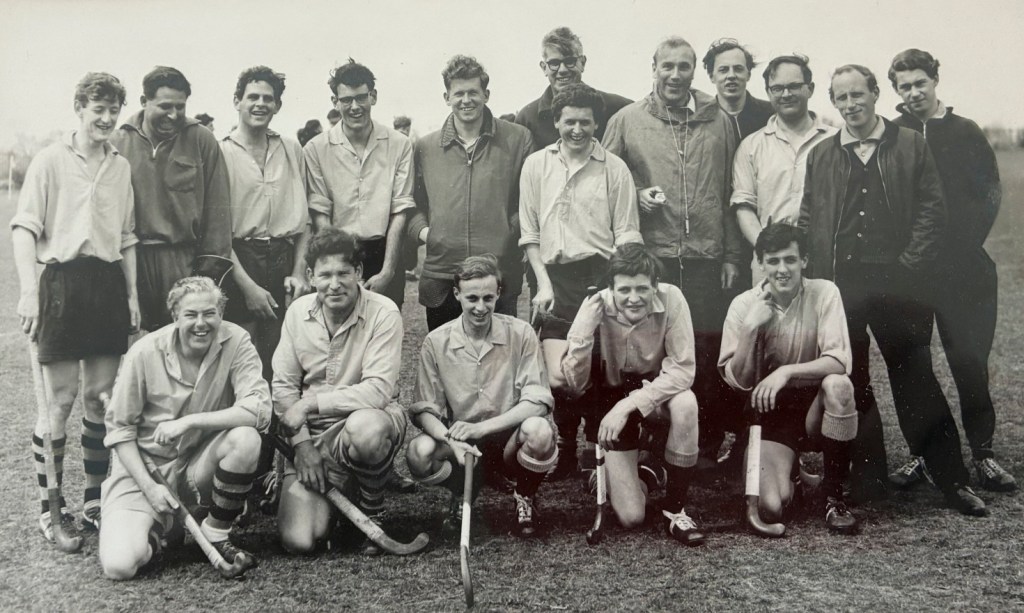
Thanet Hockey Festival. April 1965.
At the club’s AGM in 1965, I was press-ganged into becoming the fixtures secretary. In those days, all the hockey clubs in London and the Home Counties, met once a year, in an upstairs room, at the Albert pub in Victoria Street, London to arrange fixtures for the following season. Normally it was me and a number of helpers – often Tony Hawkins, Mike Reid, Chas Carson, Alan Hitchmough and Tony Wakeling. Our group would approach other clubs for matches – a lot were merely confirmation of hitherto regular fixtures, but often we would get new opponents to play, especially in latter years, for our Third and Fourth XI’s. It was quite frenetic, especially towards the end of the evening, if there were still fixture gaps to be filled. Once done, a pint of beer downstairs was exceedingly welcome. I think I held the role for eight or nine years, before Chas was appointed in my place. He certainly wasn’t press-ganged!
The following season, I played a few games for the Second XI, including scoring five goals against Petters but, in the main, Harley selected me for the First XI. Initially I played mainly on the right wing but, also at right half and my more usual position of left half. One game I didn’t participate in, was the first match of the season, away to London County Council (“LCC”). At half time Sanderstead was leading 5-0. Come the end of the match, the result was 5-6 loss! We again entered the Thanet Hockey Festival, staying at the Albion Hotel, Ramsgate, owned by Jack Rice, a rather temperamental and volatile individual, who Lycett teased unmercifully. Many decades later, I stayed at the Albion but, by then, Jack was long gone and the place had been transformed into a boutique establishment.
For a year or so, indeed into the early 1970’s, I played occasionally for the Dragons, a mixed hockey side, mainly consisting of Wallington Ladies HC and Sanderstead Mens. Later, we conscripted girls from Cheam HC, including Anne Pearce, along with some of her teammates. The only time I was ever knocked over, was by a beefy female right back, who just ran into me, to prevent me from crossing the ball.
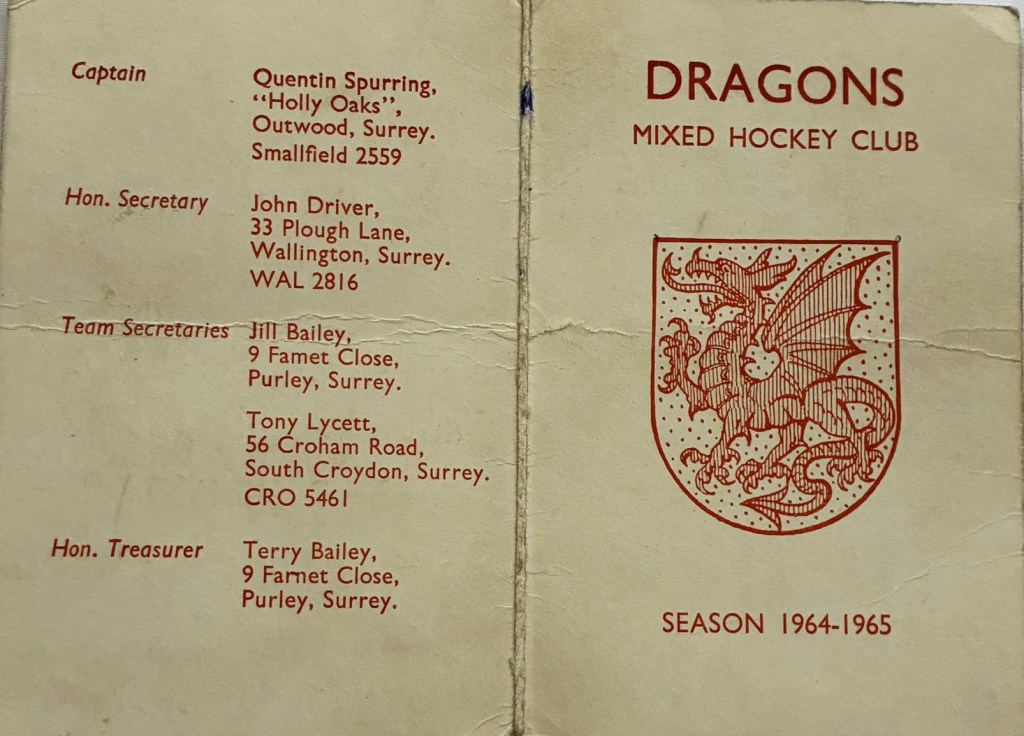
During the 1966-67 season, I was selected to play for the Hockey Association, skipperd by Andrew Foot, against my alma mater – Kent College. However, the privilege was denied me, due to the match being cancelled, on account of bad weather.
By now the pavilion at Sanderstead had been enlarged, with showers, although still no hot water – that came a year or so later. Harley loaned the club £181 to finance the work. On the subject of cost, one Saturday evening at the Red Lion, it was my turn to buy the round of drinks. I went up to the bar and ordered eight pints of beer but, was staggered to be told, that it would cost me slightly more than £1. Over 2s 6d (12.5p new money) a pint was extortionate. I recall, David Terry commiserated with me. During this period, drink/driving laws were introduced which, for a time, severely limited our intake of beer. Gradually however, old habits crept back in. A year or so later, Stuart Annan was ‘done’ for exceeding the alcohol limit and banned from driving for 12 months.
At the end of the 1967-68 season, a group of us, along with a few members of the Old Mid-Whitgiftians HC(“OMW’s”) had an Easter tour to Guernsey, organised by John Gale (an OMW). It is here that my memory is a tad hazy. I think we stayed at a hotel at Vazon Bay, or maybe it was Cobo Bay. Either way, the British Army Football team (managed by an ancient but amenable colonel, who clearly wanted a quiet life) was staying at the same hotel. The evenings were spirited, in more ways than one. On the Saturday afternoon, the Army side played Jersey FC. By the end of an apparently bad-tempered match, the Army had had three players sent off. The upshot of it was, the footballers got drunk and when the alcohol ran out at the hotel, the bar was ransacked with furniture, mirrors and chairs smashed. Fortunately, our party was out in St Helier that evening, and only witnessed the remnants of the mayhem, on our return. The other interesting thing was that the Army (almost all squaddies), had a lady in tow, who provided services, on account of free board, food, drink and a bit left over. The following morning, a few of us chatted to her; she was very matter of fact, about the whole thing.
That season we had a tour to France. We all met up at Victoria Station on a Friday night, then boarded the night train to Paris. Way before we arrived at the coast, for the short trip across the Straits of Dover, we were well pickled. I shan’t go into the finer points of the saga, but the upshot was, Colin Mackay (who later became a respected High Court Judge) in attempting to get his own back on me, attempted to pour a pint of beer over my head. Not for the first, or last time, I was too quick for Colin. Instead of wetting my head, the contents of his beer mug, went over the head of an unfortunate Frenchman, who was standing by my side, at the bar, in the buffet car. The poor fellow staggered off to his cabin, presumably to dry out, as best he could. Hungover, next morning we breakfasted at a oining the Gare du Nord, then wandered around the 10th Arrondissement, before heading to Montrouge, an inner suburb of Paris, for our hockey match. The game was scheduled to start at 3.00pm, but we had been invited to come earlier for a light meal. We all sat down at a long table, during which we enjoyed a prolonged and delicious five course lunch. We and our eleven French hosts, consumed significant quantities of beer and wine. Many toasts – a central social ritual – were given and received. By now, I and, I suspect, others in our party were quite ready, for a French styled siesta. Unfortunately, it wasn’t to be. Instead, we were summonsed to quickly change into our hockey kit, then to proceed to the pitch. This we did and were greeted by eleven of our opponents, but not the eleven who had wined and lunched with us! Somewhat surprisingly, we were two goals up in no time at all, both scored by Chris Pettipierre. However, our luck and energy didn’t last, and we succumbed to a 2-3 defeat. Just one week later, Paris exploded, with the now famous riots, the most significant social uprising in modern European history. The riots were sparked by student demonstrations, against university conditions and government repression.
At the conclusion of the 1968-69 season, Harley Sherlock resigned as First XI Captain and, in his place, Colin Mackay was elected. By then, the backbone of the First XI had departed – Lycett to Dulwich and Spurring to Purley. Bailey had emigrated to Southern Rhodesia a few years earlier. Goudie had moved to East Anglia and Driver had retired.
After all the time that has elapsed since that era, the seasons seem to roll into one. One change made was that, while tours, which strictly speaking were organised by the ‘Dragons’ to the Channel Isles continued, Thanet was dropped and, in its place, we started to tour as “The Millers” at the Torbay Hockey Festival, Torquay. With tours to the Channel Isles continuing, I didn’t go to Torquay until Easter 1971. We stayed at the Ebor Towers Hotel, Paignton and played as many as six games from Easter Friday to the following Monday. The pitches were in Paignton, Churston Ferrers, Broadsands and Torquay. Some were for full-time hockey but, most were used as football pitches, either rock hard or muddy and all bumpy and uneven. With late nights, drinking and playing silly games, like Cardinal Puff (a supposedly structured drinking game, where participants performed a series of ritualised toasts and taps), the standard of hockey rapidly deteriorated.
Traditionally on the Friday night, there was a visit to the “Brass Monkey”- a down-market pub within walking distance of our hotel, its only virtue. The next evening, it was off to the Victoria & Albert pub in Stoke Gabriel, where the resident pianist – a lady of very advanced years – played well known bawdy songs, which we sang with much gusto. Some years later, while we were there, Harley and his wife Folly got into conversation with a couple from Yorkshire – Chas and Jean McKercher. The upshot of it was, for several years, we travelled to Penistone to play hockey, against Chas’s makeshift team – the Foldring Farmers. In return, the Farmers came down to Sanderstead, for a game and a sing song afterwards, until it all got a bit out of hand and Chas, by now separated from Jean, departed, never to be seen again.
Now back to Torbay. I can’t remember what we did on Sunday nights. In those days pubs weren’t open so, we probably remained at the Ebor Towers playing more silly games, or some of us, would traipse down the hill, to the rather soulless hotel that the Old Midwifes stayed at. I liked the OMW’s – Roger Hammond, David Jackman, Norman Vaux, Mike Fleet, Barry Gough, Nick Hunwick etc – but they were much more sober and sensible than we were. Another abiding memory of Torbay was Freddie Edwards, driving through the night on the Thursday before Good Friday, then driving back home on the Easter Monday evening, so as not to miss work. Sadly, Freddie died a few years later, while playing for Wallington HC in a league match. He was in his early 50’s. Although Freddie didn’t look his age, over fifty seemed really old, not so now!
The 1968-69 season started inauspiciously; the weather didn’t help. Our first match versus GLC was cancelled. We then lost to Hawks III and Purley III, followed by the cancellation of the Cheam Hunters match. At last, we managed to draw against Epsom III but, a defeat to Bank of England followed. On 23rd November, almost two months into our season, we played Reigate II, where we scored our first goals. Quentin Spurring got the opener then, ten minutes later, I added the second, in a match that ultimately, we lost 7-2. Our losing run continued with defeats to Hawks II, OMW’s, Cheam Hunters and Bank of England again. The last game of 1968 versus Sevenoaks was cancelled, so we ended half the season without a win, having scored just six goals in nine games. The new year brought no improvement. Between 4th January and the end of the season on 19th April 1969, we had five games cancelled, drew another three, lost four but won three. A disappointing season, to say the least.
The fixtures I always looked forward to playing, were the ones against the OMW’s and Cheam Hunters. The Hunters were an amiable lot; we never had a bad-tempered game against them. With the OMW’s it was bit different; Tony Lycett, Quentin and John Driver would wind up the opposition. Mind you, David Jackman and Norman Vaux were no saints. Most games were feisty but, by the time I became captain, things had settled down. Although having said that, the only time I got sent off was at Lime Meadow Avenue in about 1973, for constantly querying Ian Scott-Brown’s umpiring decisions, when he seemed to favour the home side. I can’t have been in the OMW’s bad books because, on a few occasions, I played for them, usually, in mid-week or summer matches.
The following two seasons generally, were also disappointing. We lost games we should, on paper, have won. Individually and as a team, we under performed. It got to the stage, where I contemplated giving up the game, or joining another club. It all changed one lunchtime, during the Torbay tour. Harley had played in a match that morning and, as a result, decided to jack out of the afternoon game. I was genuinely staggered, when he asked me to skipper the side, but I agreed. Not long afterwards, I stepped onto the pitch – a tarmacked surface at Modbury – and realised that I could, not only do the job but wanted to. We won that match. Looking back, the mood within the team seemed to change; winning felt good and we all wanted more.
Between then and the club’s AGM at the end of May, I talked to virtually all the First XI players. The general feeling was, we needed to change, but how? Harley was sure things would improve, but couldn’t explain why. He then suggested that I became Colin’s vice-captain but, as I pointed out, that wouldn’t solve the problem, because Colin just wanted to carry on as before. On the day of the AGM, Harley tried to persuade me not to rock the proverbial boat. I responded, by saying that the boat was sinking. Colin wouldn’t stand down, so a vote was taken and I won by an embarrassing margin. I was captain and Ted Farrar was my vice-captain.
For several years, we had played matches in the evenings, during the summer months, many on the astroturf at the Crystal Palace Sports Centre. Previously there had been a laidback approach to these fixtures. However, I wanted to create an environment, where the team was more important than any one individual, with a collective sense of purpose. To do this, I felt I had to try, and be seen to be trying, to become the best player in the team. Whether or not I succeeded became irrelevant; my self-motivation, seemed to rub off on the other players. I was also a continual talker, urging the players on, ensuring they didn’t lose concentration or confidence, if they made a mistake.
1972-73. The Truman’s South Surrey League had started the previous year but, the club had decided not to join. On reflection, Harley concluded that it had been a mistake and, as a result, we signed up to join the league at the start of the 1973-74 season. This meant that in my first season as captain, the First XI would only be playing friendly matches. As it so turned out, it gave me a full 12 months to hone the way the team played.
So, what did my initial XI look like? Derek Tayor had swanned off to Purley and Roger Whitaker had married Gay and retired from playing aged 26! It wasn’t all bad news though. Pat Taylor and Martin Hedges, a student at the Royal School of Church Music, based at nearby Addington Palace joined us. Ted Farrar was our goalie. Colin Mackay and Freddie Edwards were the full backs. Paul Edwards, Keith Leaver and ’Chas’ Carson were the half backs. The forward line consisted of Stuart Annan, Martin Hedges, Pat Taylor, me and Richard Harris. I think the season was a success; out of 35 games played, we only lost eight.
1973-74. The team remained much the same as the previous one, except that Ted Farrar had departed, to get married, while Martin Hedges felt he needed to focus all his efforts on his musical studies. Alan Hitchmough took over in goal. Peter Patterson replaced Freddie Edwards at left back; Ian Witchell, Ronnie Dick, who became our number 9 and Ashok Maru also arrived. Nick Chatham was promoted from Tony Hawkins’ Second XI as, on occasions, was David Parsons. John Proctor came in a year or so later.
At last, we were about to play competitive league hockey, albeit, at the bottom rung of the ladder. Our first league game was a draw againstthe Civil Service, followed by four victories in a row, over Old Reigatians i, Horley 1, Kenley and East Molesey. We lost the next game 3-2 versus Old Walcountians. The new year brought us a victory over Kingston Poly and a 4-1 loss to King’s College 1. In our final league match, we beat Hersham 3-0 but missed out on promotion – Old Walcountians and King’s College being promoted to Division 2, at the start of the following season.
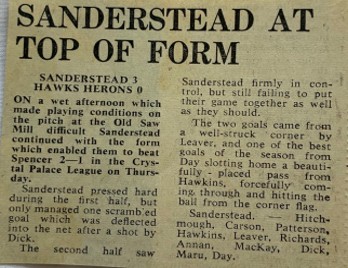
Okay, we hadn’t gained promotion. We were disappointed, but there was a feeling of togetherness. We fought for each other; there were no star players, no prima donnas. So committed to the team were the players, that hardly a match was missed, through injury or an outside activity. Quite simply, we all enjoyed being part of a team.
1974-75 Fixtures card
The season 1974-75 was characterised by good and bad games and several cancellations. In the league, the start was promising, with resounding 5-0 wins over Banstead Hospital and Claygate. We succumbed to defeat at Croydon Gas, but beat Harrodian and Hersham. Things were looking good. However, the second half of the season, saw us lose bad tempered games against Horley and Kenley, followed by another defeat to BAC. No promotion again this year. However, the fellowship was still there; surely it would be third time lucky?
The 1975-76 season
The season went well. We were focused on attacking hockey, playing high up the pitch, often with only Alan Hitchmough in our half. I also instigated a specific free hit routine. If it was near our opponents “D”, as Colin pushed the ball towards the far goal post, I would run in and attempt to flick the ball over the goal line. It worked quite well and, as a result, I scored a number of goals this way. The results I have for the season are incomplete but, from the beginning of October until 6th March, we remained undefeated, in both league and friendly matches. In the league our record was, as follows: –
Kingston Poly. Won 2-0. East Molesey. Won 5-3. Hersham. Won 2-1. Royal Holloway College. Won 3-2. Tooting Bec Hospital. Won 5-0. St. Ebba’s. Won 5-0. Banstead. Won 4-0. Westminster Hospital. Won 10-0. Claygate. Won 3-1.
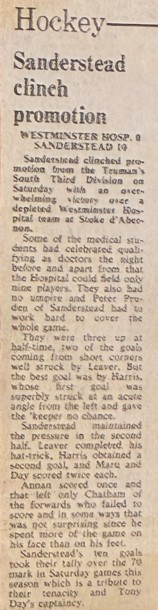
As result we were promoted to Division 2 the following season.
That April I led a team on tour to Jersey. We had several matches and thoroughly enjoyed ourselves on and off the pitch. On the Sunday afternoon, as we motored up the hill to Jersey airport, I noticed a plane taking off but thought nothing it. On arrival at checking-in, I was informed that we had missed our flight back to Southampton and that there were no more flight to the UK, until the following morning. For most of us, this meant an additional night in Jersey – no problem, but Colin Mackay had to be at the High Court and Stuart Annan had a sales appointment, on the Monday. Both managed to get back to the UK that evening one by sea, and the other by air from Guernsey.
The season 1976-77 was my fifth as captain. Could we gain promotion again? Our league matches were against Hersham, Kenley, OMW’s, Old Walcountians, BAC, Croydon Gas, Horley, Old Reigatians and St Thomas’ Hospital. We won all our games, apart from two close encounter defeats to Old Walcountians (them again!) and the OMW’s. Thus, we ended up in third place. In previous seasons, only the top two teams were promoted. However, the Truman’s League was due to be expanded the following season, so it was decreed that three teams would be promoted to the top Division. We had made it. Division 1 hockey would be ours the following season.
As usual, a month or so after the end of the season, we held our AGM. After our slightly lucky promotion winning season, it was assumed that I would be re-elected as captain, for the following season. But I had my doubts. I had taken the club from non-league hockey to the top division of the Surrey League. I thought about it a lot; Harley tried to persuade me to stay on, for one more season but, as in other walks of life, people tend to be reluctant to let go and, consequently, overstay their welcome. I was determined to go too soon, rather than too late. So, I didn’t put my name forward.
In the 1977-78 season, I felt it appropriate to step back from First XI hockey, at least for a time. So, I played in Harley’s Third XI with Guy Edie and a bunch of youngsters. For the first time since 1972, I could solely focus on my game.
Paul Edwards only lasted one season as First XI skipper. With relegation back to Division 2, he along with Nick Chatham, departed to Purley.
The following season – 1978-79, ‘Chas’ Carson was made captain. Having got engaged and moved to Hampshire, I left the club at the end of that season. Harley kindly organised a farewell club supper for me, somewhere in the depths of West Sussex. I also was given an inscribed beer mug, which I still use.
At the beginning of each season, we were invited to take part in the OMW’s 6-aside competition. Then at the end of the season, Sanderstead had their competition. I hope ‘Chas’ won’t chide me for this, but at one OMW’s 6-aside, I had to remonstrate with him, for pretending to be a centre forward, when he was supposed to be playing as a defender. The following season, I dropped him from the First XI, for several games. The point I attempted to make, was that we were a team and pursuit of personal glory, had no part in my philosophy. To be fair to ‘Chas’ he bore no grudge.
Some years after I left the club, an annual veterans’ match against the OMW’s was played at the Old Saw Mill. On a few occasions, I would drive up from Chawton, to watch the ‘old boys’ play hockey, at a more sedate pace than in the 1960’s and 1970’s. Eventually after a few years, I was persuaded to take part. I was rightly robbed of my chance, to score my 100th goal for Sanderstead, when our umpire – Ian Witchell – correctly adjudged that the ball had gone into the net, via my boot. This fixture carried on into the 2000’s.
In about 2009, I organised a club lunch, at Harley’s favourite haunt in Canonbury. It was held several times, until Harley died in 2015. After Harley’s death, a similar get together was twice organised at the Old Saw Mill, but without the club’s founder, it lost its purpose and inevitably fizzled out.
Covid came and went; I lost touch with my hockey chums and, ended my playing days in May 2024, by turning out for the LX Hockey Club, in a match at the West Warwickshire Sports Club, Solihull. Thus, almost seventy years after I picked up my first hockey stick at Kent College in 1955, I finally put it down.
Over those decades hockey changed. From muddy, bumpy pitches (KC and Bank of England were exempt) to all weather surfaces. No more ‘sticks’. No more bullying off; no tramlines, and the abandonment of the obstruction rule. All these changes, probably enhanced the game. But by playing on artificial surfaces, at any time of the day, the routine of playing on a Saturday or Sunday afternoon, then socialising afterwards, generally, was lost. In the new era, some clubs flourished (Oxted), others merged (Dulwich and Tulse Hill, Purley and Walcountians, Shell or Lensbury as it was known, Mid Surrey and NPL); while some disbanded (Hounslow, Kenley). Apart from the Bank of England, most of the major banks had disbanded their sports clubs. In the early days, in the main, the major hockey clubs, belonged to the London League. Now there is an England League (Division 1) comprising a dozen sides of which. only six, were previously in the London League. The other major change, has been the proliferation of ‘vets’ sides, the LX Club being a good example.
Of my players from 1972 to 1977, a number have since died. Certainly Freddie Edwards, Alan Hitchmough, Peter Patterson, Colin Mackay and Stuart Annan – maybe more.
However, to end on a more cheerful note, I have selected an eclectic XI, consisting of Sanderstead players, who learnt their hockey at a public school.
Goalkeeper. Howard Aplin (Canford), right back. Colin Mackay (Radley), left back. John Driver (Whitgift), right half. Ian Johnson (sorry Ian, but Stuart beat you for pace on the wing), centre half. Harley Sherlock (Canford), left half. Chas Carson (Dover), right wing. Stuart Annan (Marlborough), inside right. Tony Lycett (Gordonstoun), centre forward. Roger Whitaker (Caterham), inside left. Quentin Spurring (Whitgift), left wing. Tony Day (Kent). Subs: Ian McMillan (King’s, Canterbury). Peter Spiers (Caterham). Michael Reid (Gordonstoun). John Gale – a latecomer (Trinity, Croydon). Peter Anderson (Caterham). Nigel Whitaker (Caterham).
Finally, my apologies to the many Sanderstead players, I haven’t mentioned. It just wasn’t possible to include you all and, besides memory fades over time. I have one doubt in my mind. The year I became skipper, I mentioned a student from the Royal School of Church Music who joined the club. I thought his name was Martin Hedges, but I am now having doubts. I appreciate it was a long time ago but, please could someone help me out.
As for the hockey club, now almost eighty years old it remains, albeit, a much smaller club than fifty years ago. But it has survived due, in no small measure, to John Proctor.
** Quoted from Harley Sherlock’s book on the origins of Sanderstead Cricket Club.
September 2026
