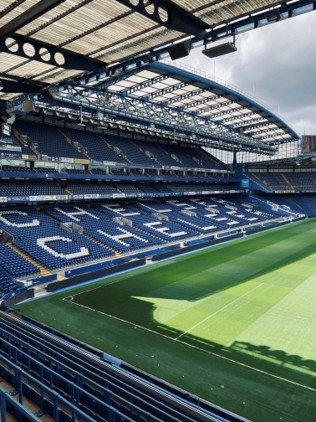
During Covid I wrote a short article headed “SIXTY SIX YEARS OF FOLLOWING CHELSEA FOOTBALL CLUB”. The first thirty years.
I don’t propose to reproduce it for this blog. Instead I will endeavour to reminisce over the now seventy one years of supporting the club, mainly players who stuck out from the rest.
To start off, the first time I saw Chelsea play, was in November 1955 at Highbury, where Chelsea and Arsenal drew 1-1. Roy Bentley scored Chelsea’s goal.
We all have football favourites; my first one was Jimmy Greaves. Jimmy made his first team debut for Chelsea in August 1957, scoring in a 1-1 draw with Spurs at White Hart Lane. In all, Jimmy scored a total of 132 goals for the club in just four seasons. He scored five goals in a match three times. The first one was at the beginning of the 1958/59 season at Stamford Bridge, against Wolverhampton Wanderers – a match I watched. Chelsea won 6-2 against a Wolves side that had Billy Wright and Ron Flowers in it. Nevertheless, Wolves ended up Division One champions that season.
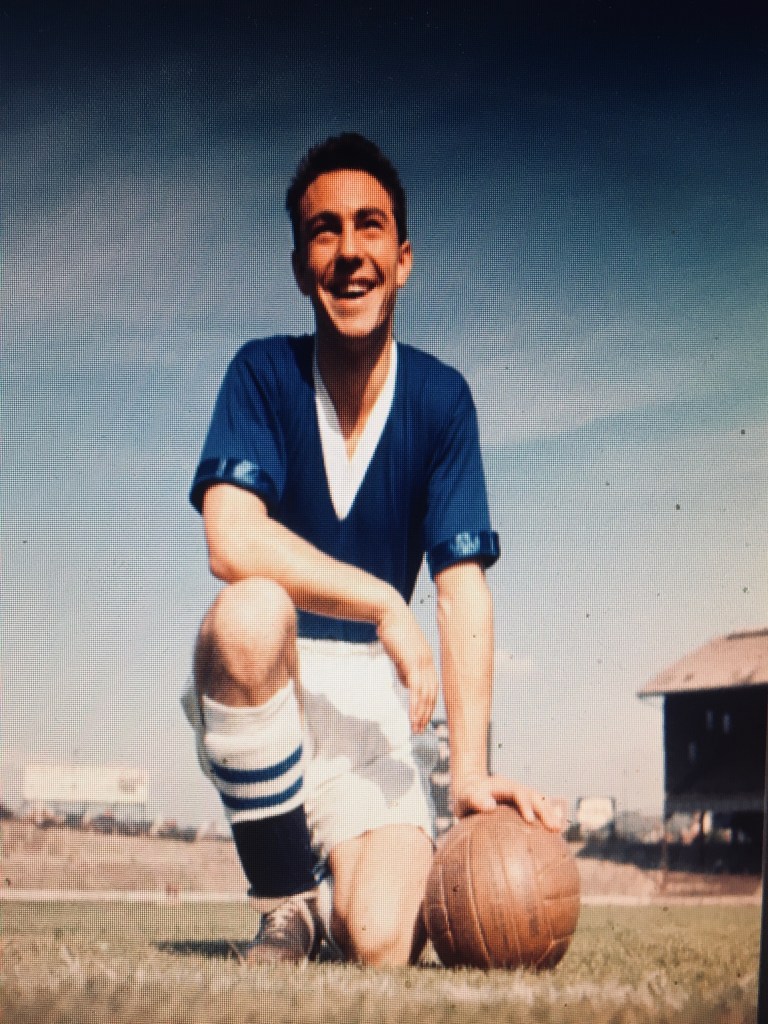
Jimmy Greaves
Another favourite was Terry Venables. While at Kent College in about 1960, I and a chum, watched an England Under 18’s game against France at the Canterbury FC home ground. Venables played that day, along with Frank Saul of Spurs.
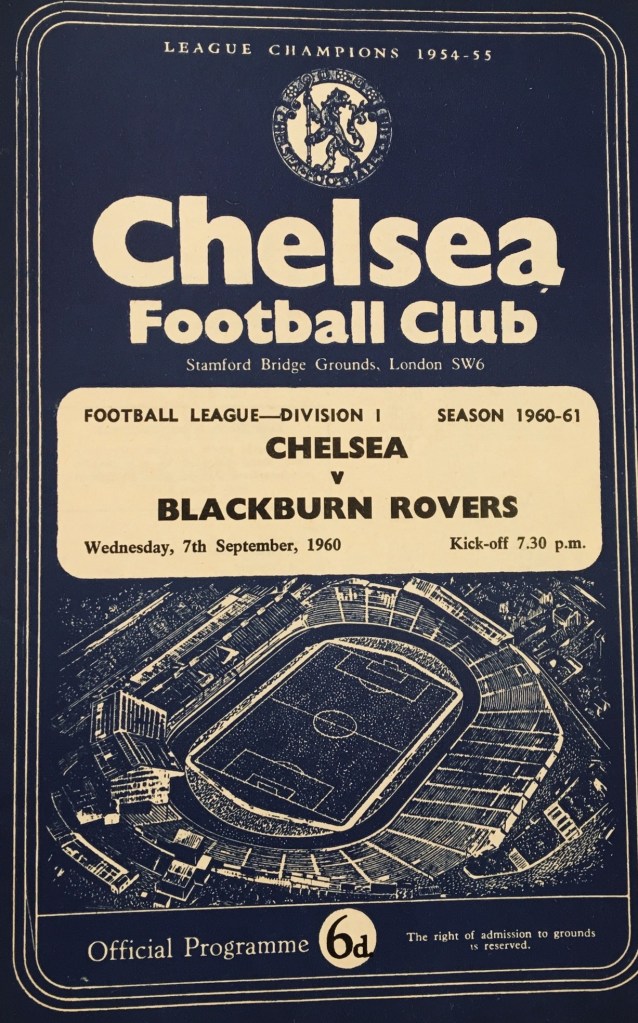
In those days, Stamford Bridge was a cavernous stadium, with the main (East) stand opposite a steep all standing uncovered terrace. There was the rather quirky North Stand adjacent to the main one, with seating on the upper level with standing space below. The only other protection from the weather, was a shelter at the Shed End – see the photo above.
In 1964 I went to watch an FA Cup match versus Spurs along with 72,000 other fans. Even the aisles and walkways were jampacked with spectators. Chelsea were victorious winning 2-0. Ron Harris kept Greaves quiet, or more likely Jimmy avoided Ron, who had a reputation for not taking prisoners.
After Greaves was transferred in 1961 to AC Milan, Bobby Tambling became my football hero. During his career, he was Chelsea’s all-time top scorer for 47 years, with 202 goals in all competitions, until Frank Lampard surpassed this total in 2013.*
In the early days, my father took me to watch Chelsea. Then, a few years later, I went with a school friend – Richard Walsh. By the late 1960’s, hockey chums – Mike Reid, Ian Johnson and occasionally Colin Mackay – accompanied me to the Bridge. In later years, I often went by myself. Then latterly with Tony Rampton.
In the 1980’s I and Chris Keatley, often watched Crystal Palace play, especially when Malcolm Allison was their manager. Johnny Byrne was their star player before moving to West Ham.
in 1966 Charlie Cooke was signed from Dundee. What a mercurial player he was. Charlie could dribble past two or three players, before flighting the ball to Tommy Baldwin or Peter Osgood.
Osgood was good! As was Alan Hudson. Two phenomenal talents, who never quite matched their undoubted potential.
The years rolled on. Chelsea won the 1970 FA Cup versus Leeds United, then a year later the UEFA Cup Winners Cup. Things were looking up, or so we thought.
The 1973/74 season saw Chelsea finish 17th with 37 points. The following season ‘Butch’ Wilkins and a few other young players were promoted. Wilkins was an exceptional passer of the ball. I remember him kicking the ball, with the outside of his foot, fully 50 yards onto the toes of one of our forwards. A notable acquisition was David Hay, the legendary Celtic footballer. His stay at Chelsea was underwhelming but, there was an aura about him. The same season saw the opening of the new East Stand. Up the back of the stand, it felt like watching the game over a cliff edge. Unfortunately the 1974/75 season ended with Chelsea being relegated to the Second Division.
The 1975/76 season was a disappointment, Chelsea finishing in 11th place. However the following season, promotion back to the First Division was achieved, by beating Hull City 4-0 on the final day. Gary Langley finished the season with 21 goals.
The start of the 1976/77 season didn’t go well. The manager Eddie McCreadie departed and Ken Shellito took his place. Ken had been a brilliant right full back for Chelsea, and surely would have been in the England squad for the 1966 World Cup but a few months before, he injured a leg and was ruled out. Shellito’s career as manager was brief.
By 1979 I was living in Chawton, Hampshire, and consequently didn’t attend any matches at the Bridge for a number of years. Chelsea’s future ebbed and flowed, mainly the former.
In April 1982, Ken Bates became the owner of Chelsea, having acquired the club for £1 from Brian Mears. The following month, manager John Neal, bought striker David Speedie from Darlington for £80,000.
Things looked bad at the end of the following season (1982/83). Chelsea were in danger of relegation to the old Third Division. However Clive Walker’s goal at Bolton, enabled us to avoid a catastrophic drop.
At the start of the 1983/84 season, Chelsea acquired Kerry Dixon from Reading for £175,000. At Reading he had been the top scorer in the Third Division in 1983. At Chelsea in 1984, he was the top scorer in the Second Division and in 1985 was top scorer in the First Division. Kerry’s first game for Chelsea ended in a 5-0 win against Derby County, when he scored twice. That season ended with him scoring a hat-trick in a 5-0 trouncing of Leeds United, which got us promoted back to the First Division. With Speedie and Dixon forming a formidable striking partnership, thanks in no small part to wingers, Pat Nevin and Paul Canoville, things were looking up.
At the end of the 1984/85 season, Chelsea were placed 6th in the First Division, with Speedie and Dixon scoring 52 goals between them. The same position was achieved the following season.
Time moved on. Managers and players came and went. Bobby Campbell succeeded Hollins as manager, who in turn was replaced by Ian Porterfield, then David Webb for a few months, before Glenn Hoddle was appointed in June 1993. During his three years at Chelsea, Hoddle persuaded Ruud Gullit to join the club. Things were seemed promising, even if results continued to disappoint. During this time Mark (‘Sparky’) Hughes joined from Manchester United. In 1996 Hoddle departed to manager the England team and Gullit was named as player manager. One of his first signings was Gianluca Vialli from Juventus, quickly followed by Roberto Di Matteo from Lazio and finally, Gianfranco Zola from Naples.
To quote the Chelsea website, Ruud “was charismatic and insightful, demanding a flowing attractive brand of the game”. In May 1997, I and David Roberts watched as Chelsea beat Middlesborough 2-0 at Wembley to win that FA Cup. Suddenly Chelsea were fashionable for the first time since Osgood, Cooke and co.
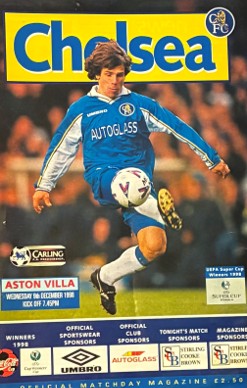
Gianfranco Zola
Gullit didn’t remain as manager for long. ‘Luca’ took his place and, for a while, we had a certain amount of success. In all ‘Luca’ scored 40 goals in 88 appearances over four seasons. During his time as a player and manager, Chelsea won the FA Cup, League Cup, Cup Winners’ Cup and EUFA Super Cup.
The year 2000 saw Claudio Ranieri appointed Chelsea’s head coach. In the summer of 2003 Roman Abramovich purchased the club and went on a spending spree – Claude Makelele, Joe Cole, Juan Sebastian Veron, Hernan Crespo and Damian Duff. The following year Jose Mourinho became manager. More players were bought – Didier Drogba, Michael Essien, Ricardo Carvalho, Petr Cech, Arjen Robben and many others. With John Terry and Frank Lampard already at the club, Chelsea won the Premiership in 2005 and 2006 and in the following years, many other trophies including the European Champions League twice.
Once Didier retired, Chelsea searched for a centre forward with little success until in 2014, they bought Diego Costa from Atletico Madrid. Diego was a controversial character but, in his three seasons at Chelsea, he played 89 matches scoring 52 goals.
After Jimmy Greaves, Charlie Cooke and Gianfranco Zola, my favourite Chelsea player was Eden Hazard. During his time at the Bridge, he scored 110 goals in more than 350 games, over seven seasons, having arrived from Lille in 2012. Eden scored many unforgettable goals but, the one against Arsenal in 2017, was in my view, the best. He left a trail of beaten Arsenal defenders behind before scoring.
In July 2023, Chelsea bought Cole Palmer (yet another of my favourite players) from Manchester City for £42.5m. In 2025, he helped Chelsea became World Club Cup Champions, beating PSG 3-0.
2026. Xabi Alonso is now the manager. We have an exciting trio up front, in Morgan Rogers, Joao Pedro and Cole Palmer. Time will tell if Xabi can be as successful at Chelsea, as he was at Bayer Leverkusen.
Most of the Chelsea players I have mentioned have been midfielders or strikers. Over they decades they had some impressive defenders. Left half Stan Harris and centre half Ken Armstrong were part of the successful Chelsea team, that topped the First Division in 1955. Mel Scott was another centre half in the late 1950’s. Later came Bobby Evans, John Mortimore, Marvin Hinton, John Dempsey, Micky Droy, Steve Wicks, Marcel Desailly, Frank Leboeuf, John Terry and Tiago Silva.
Full backs – Stan Willemse, the Sillett brothers Peter and John, Ken Shellito, Joe Kirkup, Eddie McCreadie, Dave Webb, Tony Dorigo, Dan Petrescu, Albert Ferrer, William Gallas, Ashley Cole, Cesar Azpilicueta and Reece James. As for half backs, the most memorable were Tommy Harmer, John Hollins, Ron Harris, Andy Malcolm, Tommy Docherty, Vinny Jones, Dennis Wise, Gus Poyet, Michael Ballack, Michael Essien, N’Golo Kante, Cesc Fabregas and Jorginho, not forgetting ‘Butch’ Wilkins. Kai Havertz wasn’t a bad player either, even though he subsequently moved to Arsenal. He will forever be remembered, for scoring the only goal in the UEFA Champions League Final, against Manchester City in 2021.
A mention of a few of Chelsea’s goalkeepers – Bill Robertson, Chic Thompson, Reg Matthews, Peter (the ‘Cat’) Bonetti (729 appearances for Chelsea), Petar Borota, Dave Beasant, Kevin Hitchcock, Dmitri Kharine, Ed de Goey, Carlo Cudicini and Petr Cech.
Finally, who remembers these former Chelsea centre forwards – Charlie Livesey, Graham Moore, Duncan McKenzie, Robert Fleck or Pierluigi Casiraghi?
Footnote: Not many people know it but Chelsea, as champions of England in 1955, were invited to participate in the inaugural European Cup but, the FA stepped in and stopped them.
- *Quoted from the Chelsea FC website.